
The Future of Africa is Bright
By 2050, one in four people alive will be African. Africa2060 is a private, commercial answer to the question that will define this century: whether Africa absorbs the largest youth generation in human history into productive work before the window closes.
But the math is unforgiving
Africa's median age stays under 25 through mid-century while the rest of the world ages.
Between 10 and 12 million young Africans enter the job market every year. However, the continent only creates roughly 3 million jobs.
Governments and traditional development finance have had sixty years but the gap has not closed.
Entering the workforce
12,000,000
Jobs created
3,000,000
The gap
9,000,000
Per year. Every year. Compounding.

Watch our vision of Africa
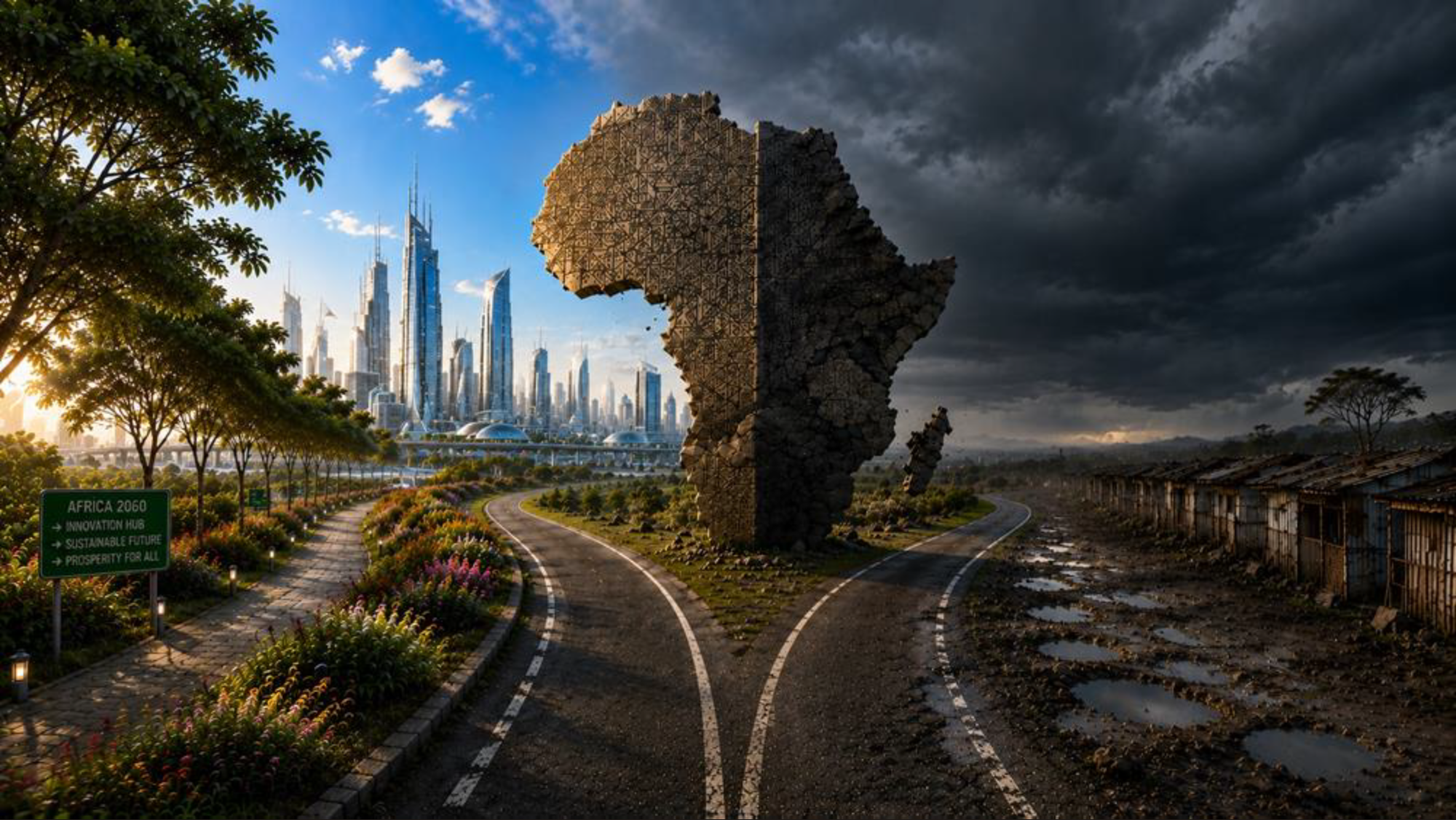
Africa’s greatest economic opportunity
A 2.5-billion-person market connected by real infrastructure. Young while the world ages. Plausibly the largest source of global growth in the second half of this century.
Or
Africa’s most destabilizing crisis of the century
Another generation of migration crises, political instability, and lost human potential at a scale the world has not had to confront before.
Do you see any other alternatives?

Africa does not have a growth problem. It has a capital, competence, and connectivity problem.
Capital
Money does not reach the businesses and people that need it most.
More than 60% of the continent is unbanked, and formal credit history often does not exist. Viable companies are turned away not because they are bad businesses, but because the financial system was never built to see them.
Competence
Businesses that get money often lack the operational depth to use it well.
The supporting tissue around African founders is thin: experienced operators, fractional executives, peers who have scaled before. A founder in Africa cannot simply hire what a founder elsewhere can. Good companies die from solvable problems.
Connectivity
Even thriving businesses cannot easily reach customers one border over.
Intra-African trade is 15–18% of the continent's total, against more than 60% in Europe and Asia. AfCFTA is a treaty. It is not a road, a port, a power line, or a payment rail. Those still have to be built.
Three anchoring companies. One system. Global participation.
Competence
GIAC
A company of twelve that operates like a company of two hundred.
GIAC lets each portfolio company be world-class at exactly one thing — manufacturing, distribution, reverse logistics, financial operations — then stitches them into a complete vertical stack. A manufacturer never builds a distribution arm. It gets paired with a distribution specialist already in the portfolio.
170+ portfolio companies · 8 countries
Capital
MaxBalo
The banks that would not lend to these businesses now refer them here.
Capital Facilitation as a Service: capital released against cash flow rather than a fixed repayment calendar, collateral insured in full, coaching built into the loan. Banks found the collateral structure more robust than their own. Insurers found that every loan is an insured asset. Both became referral channels.
$30M+ deployed · 2,700+ SMEs · 17,000+ jobs created or saved · 4 countries
Connectivity
Adifund
$95 billion a year already flows home. Almost none of it is invested.
The diaspora is not a capital pool. It is a constituency; a hundred million people who built lives elsewhere and want to build something at home. Adifund is the structure that turns that want into infrastructure: member-owned with quarterly reports on both the returns and what actually got built.
Open to all · One member, one vote · Quarterly impact reporting